


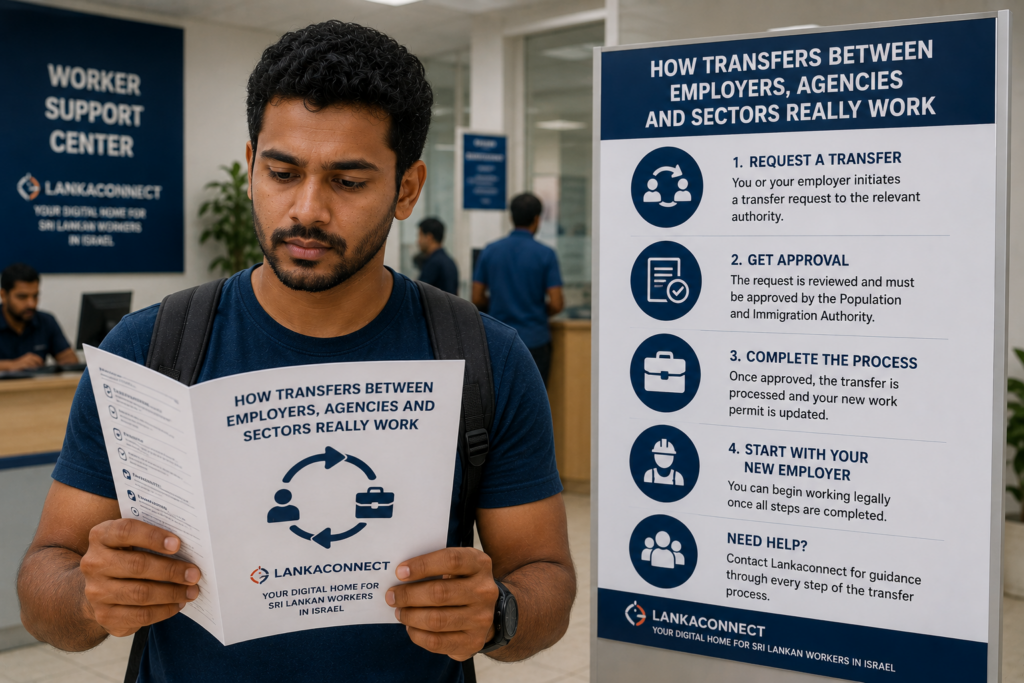
Wanting to change your employer in Israel is one of the most common things Sri Lankan workers ask about — and one of the most misunderstood. Some workers are told by their agency that transfer is impossible. Others are told they will lose their visa if they try. Some are told to just leave and start with the new employer right away. None of these is the full truth.
This article explains what the law actually says: when you can transfer, what the process involves, how long it takes, and what can go wrong. Understanding this before you make a move can protect you from mistakes that are very hard to undo.
The Binding Arrangement – What Ties You to Your Employer
When you arrive in Israel on a B/1 visa, you are legally connected to the specific employer named on your employment permit. This is called the Kvila in Hebrew – the binding arrangement. It is sometimes also called the hesdrat ha-kvila, meaning the binding framework.
What it means in practice: even if a different employer offers you better pay, even if they are willing and ready, working for them without going through the official process is illegal.
| Legal context – the kvila system is changing |
| Israel’s Supreme Court has issued rulings limiting how binding this arrangement can be – because it gives employers significant power over workers. Legal reforms in recent years have opened up more ways to transfer, especially in cases of mistreatment. The rules are still evolving. Always verify the current situation through PIBA or a legal aid organisation before you make a move. |
When Are You Allowed to Transfer?
You do not need to stay with a bad employer forever. There are legal grounds that allow a transfer:
| Reason for transfer | What this means for you |
| Employer closure or death | If your employer’s business closes, or the person you care for passes away, a transfer is usually processed quickly. |
| Documented mistreatment | If you have experienced physical, verbal or sexual abuse, or your wages have been illegally withheld – and you have this documented in writing – this is grounds for transfer. A police report or Ministry complaint strengthens your case significantly. |
| Both sides agree to end it | If your employer and you both agree to end the arrangement, a transfer can be filed. Your employer must sign release paperwork. |
| Wages unpaid for two months or more | Non-payment of wages for over two months can be grounds for transfer without the employer’s agreement in some cases. |
| Permit expired and not renewed | When your employment permit expires and your employer does not renew it, you may be able to transfer to a new employer in the same sector. |
How the Transfer Process Works – Step by Step
| 1 | Tell your agency (if you have one) that you want to transfer. Ask them to confirm this in writing. |
| 2 | Get a signed release letter from your current employer – or, if they refuse, put together your documentation of why you have the right to transfer (police report, records of unpaid wages, etc.). |
| 3 | Find a new employer who has, or can get, a valid employment permit in your sector. The new employer needs to apply to cover you. |
| 4 | The new employer submits a transfer application to PIBA with all the supporting documents. |
| 5 | PIBA reviews the application. This typically takes 2-8 weeks. During this time, your current visa status remains valid as long as you stay with your current employer. |
| 6 | Once PIBA approves the transfer and issues a new or updated permit, your new employment can officially begin. |
What Goes Wrong – and How to Avoid It
Leaving before PIBA approves
One of the most common mistakes: a worker finds a new employer, feels relieved, and leaves immediately – before the PIBA process is finished. This creates a gap where you have no valid employment arrangement and may technically be in breach of your visa conditions. Wait for written confirmation from PIBA before moving. It is hard to be patient, but the wait protects you.
Treating a WhatsApp agreement as a real transfer
An agreement with a new employer – even written on WhatsApp – is not an official transfer. Until PIBA updates its records, you are still legally tied to your original employer. We agreed is not a defence if immigration checks your documents.
Believing your agency when they say transfer is impossible
Some agencies tell workers they have no right to transfer – either because it gives the agency control, or because they genuinely do not know the current rules. An agency cannot stop you from filing a transfer application with PIBA. If you are being told transfer is blocked, call the Foreign Workers Hotline (1-800-354-554) and ask directly.
Changing Sectors – A Much Harder Process
Moving from one sector to another – say, from caregiving to agriculture, or from restaurants to a hotel – is significantly more complex than changing employers within the same sector. To do it, you generally need:
- Evidence that there is no work available for you in your current sector
- A new employer in the other sector who has an active quota slot for you
- Approval from both PIBA and in some cases the Ministry of Labour
- In some situations, leaving Israel and re-entering – though this is not always required
Because sector transfers are complicated, get legal advice before you try. Kav LaOved (03-688-2126) gives free advice to foreign workers and can sometimes represent you.
A Question Most Guides Do Not Answer: Where Do You Live During the Transfer?
This is the most practical and overlooked question – especially for caregiving workers.
If you are a live-in caregiver, your home and your job are the same place. When you start a transfer, you leave that home. But PIBA approval can take 2-8 weeks. During that time, you have no official employer and no official housing. This is a real problem that many workers only realise after they have already given notice.
| ⚠ IMPORTANT |
| Do not assume your new employer will provide housing during the waiting period without confirming it in writing first. Do not assume you can stay in your old employer’s home while you wait – once the transfer starts, that is usually not possible. Sort out your housing before you start the transfer process, not after. |
Other Sri Lankan workers in Israel have used these options during transfer periods:
- Arrange temporary accommodation with a Sri Lankan community member or fellow worker before giving notice.
- Ask the new employer directly: will you provide housing from the day I leave my current employer? Get this in writing.
- Contact Hakeren (050-575-0054) or the Association for Civil Rights in Israel (ACRI) – they sometimes know of emergency housing options for workers in transition.
- The Sri Lankan Embassy, 1 Ben Gorion Street, Bnei Brak | +972-3-527-7635) can sometimes connect you with community resources in urgent situations.
| Housing rule for transfer planning |
| A practical rule: before you start any transfer process, you should already know where you will sleep on the first night after leaving your current employer. If you do not know that yet, you are not ready to begin. |
| ✓ QUICK TIP |
| Keep all your salary slips, your contract and any written communications with your current employer saved somewhere safe before you start the transfer process. If your employer makes any complaints or claims against you during the transfer, this documentation is your protection. |
| Have a question about this? |
| Still not sure? Ask the Expert. I want to transfer employers but my agency is telling me it is not allowed. Is that true? What are my rights? The LankaConnect Ask the Expert corner is here for exactly these questions. Real answers, in Sinhala or English, from people who understand the Israeli system. Go to: LankaConnect.com/ask-the-expert |