


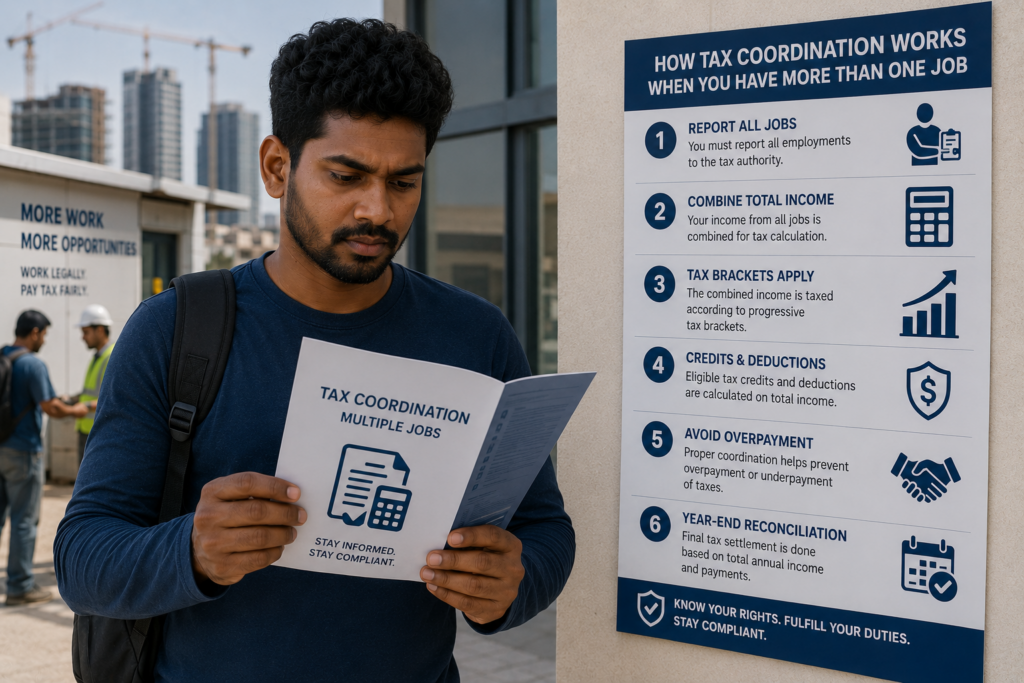
Many workers think that getting a second job is only an employment issue. In reality, it is also a tax issue. When one person earns salary from more than one employer, tax withholding can become inaccurate if the system is not coordinated properly.
This is where tax coordination becomes important. The Israel Tax Authority provides an online service for employees who receive wages from more than one employer. The purpose is practical: to reduce the risk that too much tax will be withheld during the year or that salary will be taxed in a way that does not match the worker’s real annual picture.
For foreign workers, this subject can feel even more complicated because it combines payroll, forms, language barriers, and multiple employers. But the core idea is simple. If you have more than one source of salary income, you should not assume that both employers will automatically know how much tax should be withheld overall.
What tax coordination means
Tax coordination is a formal process used to determine how tax should be withheld when a person has more than one source of income or needs certain tax reliefs reflected correctly during the year. In the context of two jobs, the main goal is to prevent the second employer from withholding tax in an unnecessarily heavy way just because they do not have the full annual picture.
Without coordination, the payroll system at an additional job may apply a high withholding approach. Workers often discover this only after seeing a low net salary. Then they ask, “Why is my second job paying me so little?” In many cases, the answer is not the wage rate itself. The answer is the tax treatment.
Who can use the online service
The Israel Tax Authority states that employees who receive wages from more than one employer can perform tax coordination online. The same official service also handles some requests for tax relief in deductions. The service is free of charge.
The official guidance also explains that some people cannot use the online route in certain cases, such as people with many income sources or other special circumstances. In those situations, contact with the relevant tax office may be required instead.
Why workers with two jobs often overpay during the year
Imagine a worker with one main employer and one smaller part-time employer. The main employer may know that most of the worker’s monthly income comes from that job. The smaller employer, however, may withhold tax cautiously because it cannot see the full income picture. If no coordination is done, the worker may end up paying too much during the year even if the annual tax result should have been lower.
This does not always mean the employer made a mistake. It often means the employer followed a default withholding logic because there was no coordination approval to guide payroll.
What to prepare before doing tax coordination
The Tax Authority explains that before conducting tax coordination online, it is helpful to prepare the deduction file numbers of the employers or payers and preferably a payslip from each employer so the relevant salary data is available. Supporting documents for any requested tax relief should also be prepared when relevant.
In practical terms, a foreign worker should gather: ID and visa details, a recent payslip from each employer, the employer names, the start date of each job, and any document already received about tax withholding. If the worker cannot read every document easily, translation support is worth arranging before submission.
How the process works in simple language
First, the worker identifies that there is more than one salary source. Second, the worker gathers payslips and employer details. Third, the worker uses the online service or another official route if required. Fourth, the system issues certificates or instructions that must be given to the employers so payroll can apply the coordinated withholding.
This last step is very important. Getting approval is not enough if the employers never receive it. Save the certificate and make sure the relevant payroll person receives it.
Main job and additional job: why the difference matters
In day-to-day language, workers often speak about a “main job” and a “second job.” This is useful because the salary level is usually not the same in both places. Tax coordination helps place the withholding more rationally across the income sources.
A worker should never guess which employer is already using the correct instruction. Check the payslip and confirm in writing if the coordination document was applied.
Practical example 1: weekend second job
A worker has a full-time weekday job and a small weekend job. The weekend employer withholds heavy tax because no coordination document was submitted. After coordination is completed and the certificate is delivered, the payroll at the second job can apply the new instruction. The worker’s net pay becomes more reasonable.
Practical example 2: changed the income balance during the year
At the beginning of the year, one job was clearly the main income source. Later, the second job grew and became much larger. In this situation, the earlier coordination may stop reflecting reality. The worker should check whether an update or correction is needed.
The Tax Authority notes that if a person already prepared a tax coordination for the current tax year, an update or correction can be made in the system. This matters because many workers think one submission at the start of the year is enough forever. It may not be.
Practical example 3: did not coordinate and now the year ended
A worker had two jobs for several months, did no tax coordination, and noticed later that the second job withheld a high amount of tax. The year ends. All is not necessarily lost. The official guidance explains that if too much tax was paid, a refund may be requested up to six years back from the end of the tax year. This is one reason workers should keep all payslips and year-end summaries.
Common mistakes to avoid
Do not assume that the second employer automatically knows your tax situation.
Do not think that having a small second job means tax coordination is unnecessary.
Do not forget to give the approval certificate to the employers after it is issued.
Do not ignore major income changes during the year. An update may be needed.
Do not throw away payslips from either job.
Simple checklist
List every employer you worked for during the year.
Keep one recent payslip from each employer ready.
Save employer deduction file details when available.
Complete coordination through the official route.
Send the approval to payroll and keep proof that you sent it.
Review the next payslip to see whether the update was applied.
How to ask the employer the right question
A useful message is: “Hello, I completed tax coordination for this year. Please confirm that payroll received the certificate and tell me from which salary month it will be applied.”
This message is better than simply asking, “Why is my tax high?” It connects the question to a specific document and payroll action.
Conclusion
Tax coordination is one of the most important practical tools for workers who have more than one job in Israel. It helps prevent unnecessary over-withholding and gives payroll a clear official basis for handling tax.
For foreign workers, the best strategy is simple: recognize the issue early, gather payslips from every employer, use the official process, deliver the approval to payroll, and review the next salary slip carefully.
This topic should be explained on a website in direct language because workers need action steps more than theory. A clear article can save months of confusion and sometimes a meaningful amount of money.