


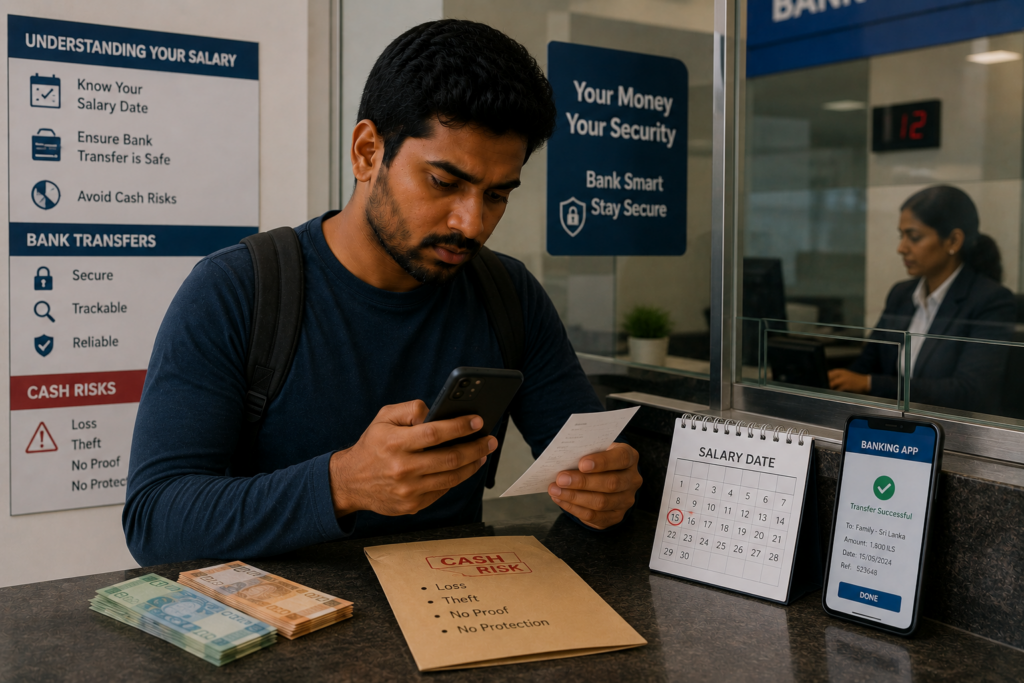
Receiving salary is not only about how much money comes in. It is also about when the money arrives and whether the payment can be proved. A salary that comes late, arrives in parts, or is partly handed over in cash can create stress even when the monthly amount looks acceptable on paper.
This article explains how salary dates, bank transfers, and informal cash payments affect everyday financial stability. It is designed to help workers check payday properly and avoid confusion that starts after the payslip is already issued.
Why timing matters more than many workers think
A payment problem does not always begin with a missing amount. Sometimes it begins with a delay. Rent, food, transport, and family transfers often follow a calendar. When salary misses that calendar, the whole month becomes harder to manage.
The payment method matters as well. A bank transfer leaves a trail. Informal cash does not. The more difficult the payment is to trace, the more difficult it becomes to prove what really happened later.
That is why salary timing should be treated as part of salary security, not as a secondary issue.
What to keep every payday
Workers should save the payslip, screenshots or confirmations of incoming transfers, and any written message about when salary was sent or why it was delayed. The key is to keep the proof by month so the story stays easy to reconstruct later.
Exact legal timing rules and payment arrangements should still be checked against current official guidance and the worker’s sector, but the editorial principle is stable: clear proof is always safer than memory.
A payday routine that prevents confusion
First, know your normal payday and write it down. If payment is usually expected by a certain date, compare each month against that expectation instead of trying to remember later.
Second, compare the payslip date with the day the money actually reached the account. A payslip may show processing, but the account shows reality.
Third, save the incoming transfer confirmation as soon as it appears. This takes very little time and becomes valuable when questions come up months later.
Fourth, if any part of the salary is handed over in cash, ask for a clear written note showing the amount, the date, and which month that payment belongs to.
How different payment methods change the risk
Bank transfers are usually easier to check because the worker can show the exact date and amount. That makes follow-up conversations much cleaner.
Cash is more fragile. It can be remembered differently, mixed with other money, or denied later. If cash is used at all, it should be documented immediately and tied clearly to the month in question.
Workers should also watch for split payments. Part of the salary may arrive on one day and the rest later. That may have an explanation, but it should still be tracked carefully because split timing affects planning and can hide confusion.
Late payment should not become “normal” just because it repeats. A pattern of delay affects budgeting, family support, and trust in the whole payroll process.
Real-life examples
Example 1: A worker receives the payslip on time and assumes payment has been made. Two days later the account still shows no deposit. Because the worker checks both documents, the delay is noticed quickly.
Example 2: Part of the salary is given in cash, but nothing is written down. A month later there is disagreement about whether the full amount was actually paid. The problem is no longer only the money; it is the missing proof.
Example 3: A worker notices that salary arrives later each month and starts recording the dates. After several months the pattern is clear and much easier to raise professionally.
Example 4: A worker sends money home immediately after seeing the payslip, but the bank transfer lands later than expected. A safer routine is to wait for confirmed payment before making large outgoing transfers.
Common mistakes to avoid
Do not assume that a payslip means the money is already in the account.
Do not treat undocumented cash as safe proof of payment.
Do not delete transfer messages or screenshots too quickly.
Do not plan major spending from expected salary before you confirm that the money actually arrived.
A practical payday checklist
Know your usual salary date and note any change.
Check the real bank transfer date and amount every month.
Save proof of incoming salary payments.
Keep the payslip and payment proof together for the same month.
Ask for written confirmation of any cash payment.
Track repeated delays as a pattern, not as isolated accidents.
How to ask about a late or unclear payment
Use a short message with the date and amount: “My payslip was issued, but I have not yet received the salary in my bank account. Please confirm when the payment was sent.”
If part of the payment was made in cash, mention that separately and ask for confirmation in writing. Separating timing, transfer, and cash issues keeps the discussion clearer and stronger.
Conclusion
Salary security is not only about the total amount. It also depends on timing, traceability, and clear proof.
The safest monthly habit is straightforward: know the payday, confirm the deposit, save the evidence, and document any cash immediately.
These habits make budgeting easier, reduce avoidable stress, and give workers a stronger position if payment problems appear.