


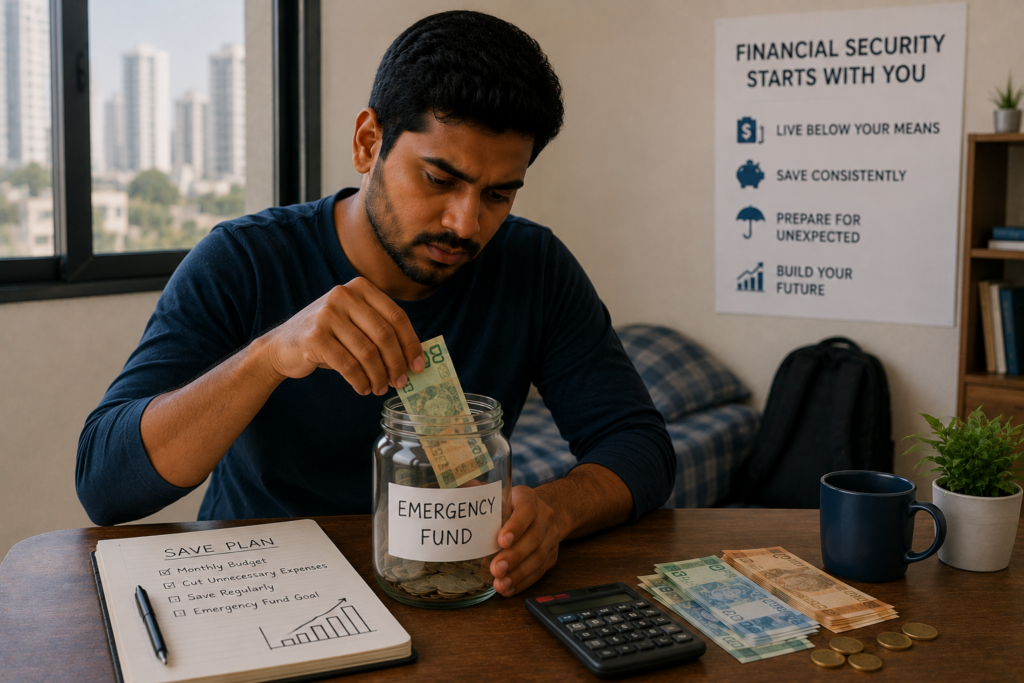
An emergency fund is money that is kept only for real surprises. It is not the same as rent money, food money, remittance money, or savings for a future goal.
For many foreign workers in Israel, this fund is the difference between a short problem and a financial crisis. A delayed salary transfer, a medical payment, an urgent ticket, a legal document fee, a broken phone, or a few days without work can quickly destroy a monthly budget if there is no backup cash.
This guide is written in simple, practical English for workers who need realistic steps. The aim is not perfection. The aim is to build protection step by step, even on a modest salary.
Why an emergency fund matters so much
Foreign workers often support more than one life with one salary. The same income may need to cover living costs in Israel, money sent home, important travel or document costs, and small family emergencies from abroad. That means there is less room for mistakes.
A worker with no emergency fund is pushed into bad decisions faster. He may depend on other people at the wrong time, delay a needed doctor visit, miss a visa-related payment, or send all his salary home and then have nothing left in Israel for transport and food.
A worker with even a small emergency fund has time to think. That is the real power of emergency savings. It buys breathing space.
What counts as a real emergency
A real emergency is an expense that is important, unexpected, and hard to delay. Examples include urgent medical costs, sudden travel because of a family crisis, replacing a phone that is needed for work and banking, temporary loss of income, or paying for a document that affects legal status or work continuity.
A sale on a new phone is not an emergency. A festival weekend is not an emergency. A gift requested by relatives is not an emergency. Buying because you feel stress or guilt is also not an emergency.
This difference matters. The emergency fund must stay protected. Once workers begin using it for ordinary spending, it stops being a safety tool and becomes just another pocket of money that disappears.
Your first target should be small and clear
Many financial guides talk about saving several months of expenses. That is a good long-term goal, but it can feel impossible for workers who are already carrying rent, food, and remittances. A more useful approach is to build in layers.
Start with a first emergency goal that feels real: enough to cover one urgent week, one urgent medical visit, one document problem, or one surprise transfer delay. For some workers, that may be 500 NIS. For others, it may be 1,000 or 1,500 NIS. The exact number matters less than the habit of protecting it.
After that, move to the second goal: one month of essential local expenses in Israel. That usually means rent or room payment, food, transport, phone, and basic daily costs. Later, if income becomes more stable, the worker can build toward two or three months of essential expenses.
The logic is simple: first create a cushion, then create real resilience.
How to calculate the right amount for your life
Do not copy another worker’s number. Build your own number from your real life.
Take one paper or note on your phone and write only your essential monthly expenses in Israel. These usually include housing, food, transport, phone, small hygiene needs, and any fixed payment that cannot be missed. Do not include entertainment, non-urgent shopping, or optional transfers.
Then look at the costs that usually create panic when they appear. For one worker it is a flight. For another it is a passport renewal, document translation, or urgent move to another room. Add a realistic buffer for those risks.
Now you have a better emergency target: essential living costs plus the kind of shock that is most likely in your situation.
Where to keep the money
The best emergency fund is easy enough to reach in a real problem, but not so easy that you spend it casually.
For many workers, the safest structure is to keep most of the emergency fund in a bank account and a very small amount in cash for immediate needs. Too much cash at home creates risk: loss, theft, pressure from friends, or simple overspending.
Try not to mix emergency savings with your main spending balance. If your salary enters one account and you use the same account for daily expenses, the emergency fund can disappear without you noticing. A separate savings pocket, a second balance, or even a clearly labeled manual tracking system is much safer.
Also remember access. If all your money is stored in a place that becomes hard to reach on a holiday, weekend, or during a technical problem, that fund may fail you exactly when you need it.
How to build the fund on a tight salary
Most workers do not build emergency savings through one big deposit. They build it through repeated small decisions.
The strongest method is to save immediately after salary arrives, not at the end of the month. End-of-month money is usually already claimed by other needs. Even a small automatic or same-day manual transfer is better than waiting to see what is left.
Another strong method is to save from irregular income. If you get holiday work, overtime, a tax correction, or an unusually good month, decide in advance that part of that money goes directly to emergency savings.
Some workers do well with a percentage rule, such as saving five or ten percent of income until the first target is reached. Others do better with a fixed amount, such as 150 or 250 NIS every salary day. The best method is the one you can repeat without failing after two weeks.
It also helps to reduce one leak instead of trying to cut everything. For example, if food delivery, late-night convenience purchases, repeated taxi use, or extra card fees are draining the budget, choose one leak and close it for two months. That saved money can become the emergency fund.
A simple monthly system that works
A practical system can look like this:
Salary day: move the savings amount first.
Week 1: pay housing and the biggest fixed bills.
Week 2: send the planned family remittance, not an emotional amount.
Week 3: review what is left and correct small overspending.
Week 4: do not touch the emergency fund unless the event is truly urgent.
This kind of system is boring, and that is exactly why it works. Stability usually comes from routine, not from motivation.
Common reasons workers fail to keep emergency savings
One common reason is mixing emergencies with family pressure. A worker may save carefully, then receive a sudden message from home and send the backup money before checking whether the family issue is urgent, temporary, or already solved by someone else.
Another common reason is keeping the goal too vague. When the fund is called ‘maybe savings’ or ‘extra money,’ it gets spent. When it is named clearly as emergency money, people protect it better.
A third reason is shame. Some workers avoid building an emergency fund because the first amount feels too small. But 300 NIS that stays untouched is stronger than a perfect plan that never begins.
Another failure pattern is restarting every month. The worker saves, spends it on something non-urgent, feels bad, and begins again from zero. A better method is to stop, rename the mistake honestly, and rebuild without drama.
Real-life examples
Example 1: A caregiver sends almost the full salary home every month because the family expects a fixed amount. Then one month the salary transfer is delayed by four days. Without backup money, the worker struggles to cover food and transport. If the worker had kept even a small local cushion, the delay would have been stressful but manageable.
Example 2: A worker shares a room and keeps all savings as cash because it feels simpler. One day the cash goes missing. There is no proof, no protection, and no recovery. This is why full cash storage is dangerous.
Example 3: A worker builds a first fund of 1,000 NIS and then uses 600 NIS for a holiday trip because the ticket seems cheap. Two weeks later, an urgent passport-related cost appears. The problem was not saving ability. The problem was using emergency money for a non-emergency.
How this connects to remittances and long-term goals
Many workers try to build everything at once: family support, future savings, and emergency savings. That often collapses because the categories are not separated.
Think of the money in three layers. First layer: survival money for this month. Second layer: emergency money for surprises. Third layer: goal money for the future, such as land, a house, education, a wedding, or a business.
If the second layer does not exist, the third layer is always in danger. One emergency will destroy the long-term plan.
Useful rules that protect the fund
Name the fund clearly in your phone notes or account label.
Save into it on the same day each month.
Do not discuss the exact balance with many people.
Keep a record of when you use it and why.
If you use some of it, rebuild before increasing entertainment or optional shopping.
Review the target every three to six months because rent, work conditions, and family duties can change.
Simple checklist
Know your first emergency savings target.
Write your essential monthly expenses in Israel.
Choose where the money will be kept.
Move money into the fund on salary day.
Do not use emergency savings for ordinary spending or emotional remittances.
Review the fund balance once a month.
Conclusion
A strong emergency fund does not begin with a high salary. It begins with a decision: some money must stay in Israel to protect the worker’s stability.
The first goal should be realistic, visible, and protected. After that, the fund can grow slowly into one of the most valuable financial tools a foreign worker has.
In the real world, emergency savings are not just about money. They reduce panic, reduce dependence on other people in difficult moments, and give a worker more control at the exact moment life becomes difficult.