


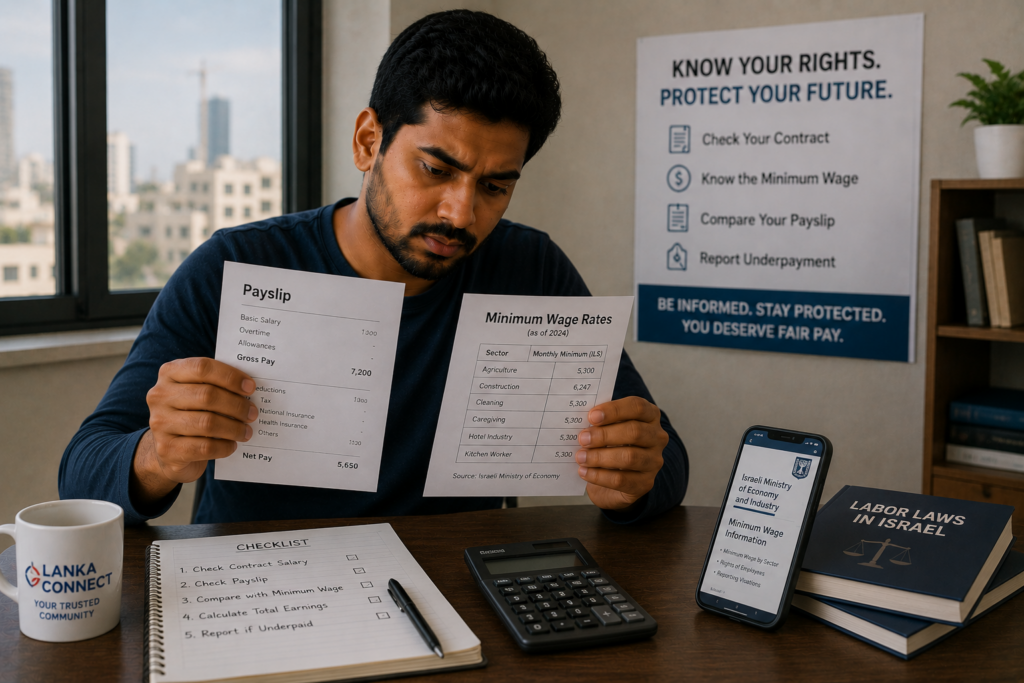
Underpayment is not always dramatic. Sometimes it is two missing workdays. Sometimes extra hours disappear. Sometimes the payslip looks normal but the bank deposit is lower than the slip. Because the differences can be small, many workers feel that something is wrong long before they can prove it.
This article shows a practical way to check whether you may be underpaid by comparing four things: the work you actually did, the rate you expected, the payslip, and the payment that really arrived.
The purpose is not to turn workers into payroll experts. It is to give them a repeatable monthly method that makes salary problems easier to spot and easier to explain.
Why workers miss underpayment at first
Underpayment often hides inside ordinary routine. A busy worker remembers the month felt heavy, sees money enter the account, and assumes the difference may be too small or too complicated to challenge.
There is also a confidence problem. Some workers hesitate because they think they may have misunderstood the system. Others notice something odd but postpone checking until the next month. By then the details are already less clear.
That is why a checking method matters. Once the review becomes mechanical rather than emotional, workers stop asking “Am I imagining this?” and start asking “Which number changed, and where?”
What to collect before you compare numbers
To review possible underpayment properly, gather the month’s attendance record, work schedule, messages about shift changes, the payslip, and proof of payment to the bank or in cash. Even a simple phone note with dates and hours can be useful.
Exact legal entitlements can vary by sector, schedule, and current rules, so important disputes should still be checked against updated official guidance and the worker’s real work conditions.
The four-step check that works in real life
Step 1: write down what you believe the month should have produced. Include days worked, hours, extra hours, rest days if relevant, and any special payment that was clearly agreed.
Step 2: compare that expectation with the payslip. Look for missing days, fewer hours, a lower rate than expected, or deduction lines that reduce the final amount unexpectedly.
Step 3: compare the payslip with the actual payment. If the payslip looks correct but the bank transfer is lower, the problem is still real. If the amount arrived in parts, note that clearly.
Step 4: if you find a gap, ask about one month at a time and attach the relevant proof. One clean month is easier to solve than a mixed complaint covering half a year.
Where underpayment usually hides
In practice, underpayment usually appears in one of four places: missing workdays, missing extra hours, a pay rate that does not match the worker’s understanding, or a deduction that reduced the final amount more than expected.
That is why it helps to split the review into two separate questions. First: was I paid correctly for the work I did? Second: was the final amount reduced correctly after the salary was calculated?
Workers should also compare similar months. If two months had nearly the same work pattern but one month paid noticeably less, that difference deserves a closer look even before you know the exact reason.
A short personal worksheet is often enough. It does not need to be formal. What matters is that the worker can recreate the month in a clear sequence.
Real-life examples
Example 1: A worker records 27 workdays, but the payslip shows 25. The issue is no longer a vague feeling. It is a two-day gap that can be checked directly.
Example 2: A worker receives the usual bank amount, but the payslip no longer shows extra hours that appeared in earlier months. The underpayment risk sits in what disappeared from the slip, not only in the final deposit.
Example 3: A worker feels underpaid every month but keeps no private note of attendance. After starting a simple monthly log with dates and hours, the worker finally has a clear basis for comparison.
Example 4: A worker believes the employer reduced salary unfairly, but the review shows that the real issue is not base pay; it is one unexplained deduction line. Good checking helps name the right problem.
Common mistakes to avoid
Do not wait several months before checking. The earlier a difference is noticed, the easier it is to trace.
Do not rely on memory alone. A strong feeling is understandable, but dates, slips and payment proof make the case stronger.
Do not send a message saying only, “My salary is wrong.” Name the month, the amount, and the likely reason.
Do not mix too many months in one conversation. Solve one month clearly, then move to the next if needed.
A simple self-check before you raise the issue
Keep your own monthly record of days and hours.
Save every payslip and payment confirmation.
Compare expected pay, payslip pay, and actual payment received.
Check whether the work pattern was similar to earlier months but the amount changed.
Look separately at earnings and deductions.
Ask about differences in writing and save the replies by month.
How to raise an underpayment concern
A useful message is direct and neutral: “I checked my July record and my payslip. I worked 27 days, but the slip shows 25. Please review and explain the difference.”
If extra hours or another item is missing, mention that as a separate point. Clear separate points are easier to answer, easier to translate, and easier to prove later. If the reply comes by phone, send a short written summary afterward.
Conclusion
Checking for underpayment is really a monthly control habit. Workers do not need complicated math. They need a basic work record, the payslip, payment proof, and the discipline to compare them in the same order each month.
When a problem is found early, it is much easier to correct the month, understand the reason, and prevent the same pattern from repeating later.
The strongest protection is consistency: track the work, read the slip carefully, verify the payment, and speak up when the numbers stop matching.