


Keywords: police questions rights Israel, right to silence Israel, police search rights, foreign worker police, right to lawyer Israel, LankaConnect guide
After police contact, many workers replay the event and ask what their rights actually were. The honest answer is that rights depend on the setting. A quick street check, a room search, a long interview, and a formal arrest are not the same situation — and the rights that apply shift depending on which one you are in.
This article focuses on the practical edge of that question: what you should not rush into, what you can say calmly, and which habits protect you when stress or language makes everything harder.
Stay calm and stop before guessing
Pulling away, hiding items, or turning a confusing encounter into a physical confrontation makes every possible outcome worse. That is the first rule, and it stays true regardless of whether the stop is fair or not.
The second rule: stop before guessing your way through questions you do not understand. Ask for slower speech or simpler language. A wrong answer given under pressure is harder to correct later than a pause to clarify.
Questions on the street or at the door
Police may ask who you are, where you live, where you work, and what you are doing there. Give basic identifying details truthfully. When you do not know an exact detail, say so rather than inventing an answer. A small lie told in panic tends to look like a larger problem later.
Once questions become longer or more serious, ask calmly what the issue is and whether you are free to leave. Listen carefully to the exact words. The difference between “please wait” and “you are detained” matters significantly for what happens next.
Your right to silence
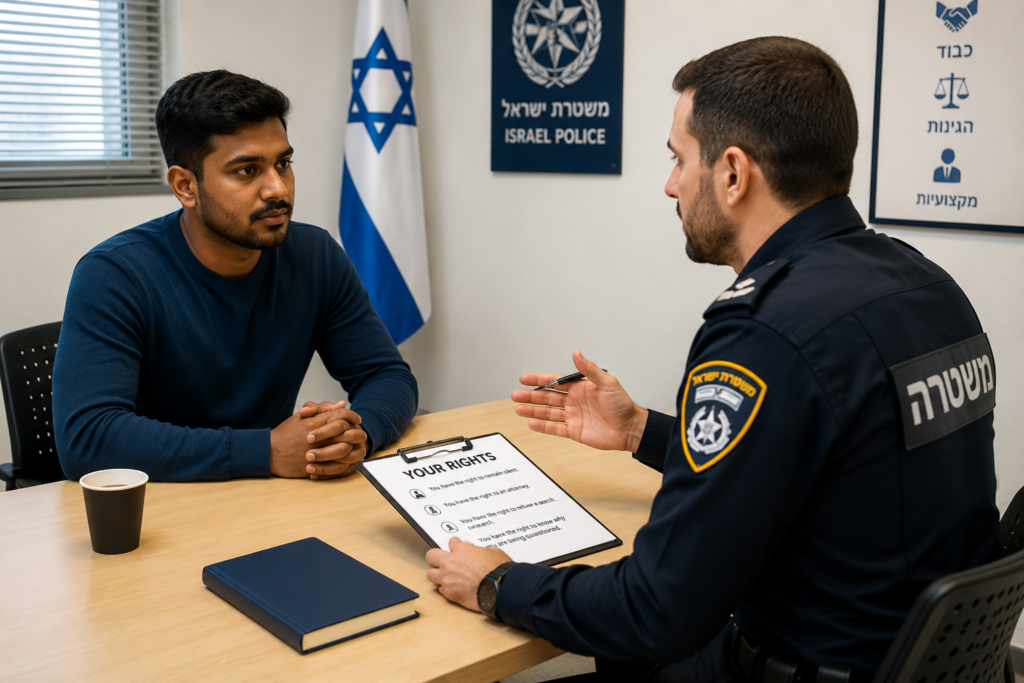
Under Israeli law, a person who is formally detained or under arrest is not required to answer police questions before consulting with a lawyer. This right exists for foreign workers too. You can say clearly: “I would like to speak with a lawyer before answering questions.”
Using this right is not defiance. Many workers talk their way into serious problems that silence would have avoided — answering questions in a language they do not fully understand, while scared, without legal guidance, and later discovering that their words were recorded in ways they did not expect. The risk of speaking too soon is higher than the risk of asking to wait.
When police want to search
Searches are high-stress because many workers do not know what is allowed, what is routine, and what they can ask. Stay physically calm and build a record rather than resisting: who searched, where, what they took or opened, whether they photographed anything, whether they handed you any paper.
When a room, locker, car, or bag is searched, write down exactly what area they covered and what they removed or copied — the same day, before memory fades. That record matters far more than you expect if you later discover missing cash, missing documents, or damage you cannot explain.
Your right to a lawyer
Ask for legal help early rather than late. Under arrest or formal questioning in Israel, you have the right to consult with a lawyer before answering. Ask for it.
When you do not understand Hebrew well enough to read a document confidently, say so before signing, not after. A signature on a page you did not understand can become a very expensive mistake. Ask for the contents to be explained. If no translation is offered, repeat the request rather than guessing.
What makes a bad situation worse
Arguing using what a friend told you about the law, instead of focusing on the facts in front of you.
Reaching suddenly for your phone to film — that movement can be misread. Stay still and say calmly if you want to record.
Deleting messages, hiding objects, or trying to clean things up in real time. Those actions almost always look worse than the original issue.
Talking too much because you are nervous. Answer the question being asked — nothing more. Too much talking creates inconsistencies that are hard to undo.
Write it down afterwards
As soon as you are safe, build a timeline. Write the place, time, the reason they gave for the stop, what they asked you, anything they searched, anything they took, any paper they handed you, and whether you were free to leave. Save photos of any documents and keep digital backups.
When your passport or official document is involved, when you were pressured to sign, or when an interview ran long, get legal advice quickly. Start with HaKeren (1-800-354-442) — free, multilingual, experienced with foreign worker situations.
Conclusion
Rights help only when you can still use them while your heart is racing. That means building steady habits before anything goes wrong: know you have the right to silence, ask whether you are free to leave, never sign blindly, and write down what happened as soon as you can.
Most police encounters that turn costly do so because someone spoke too much, signed too fast, or forgot to record what happened.