


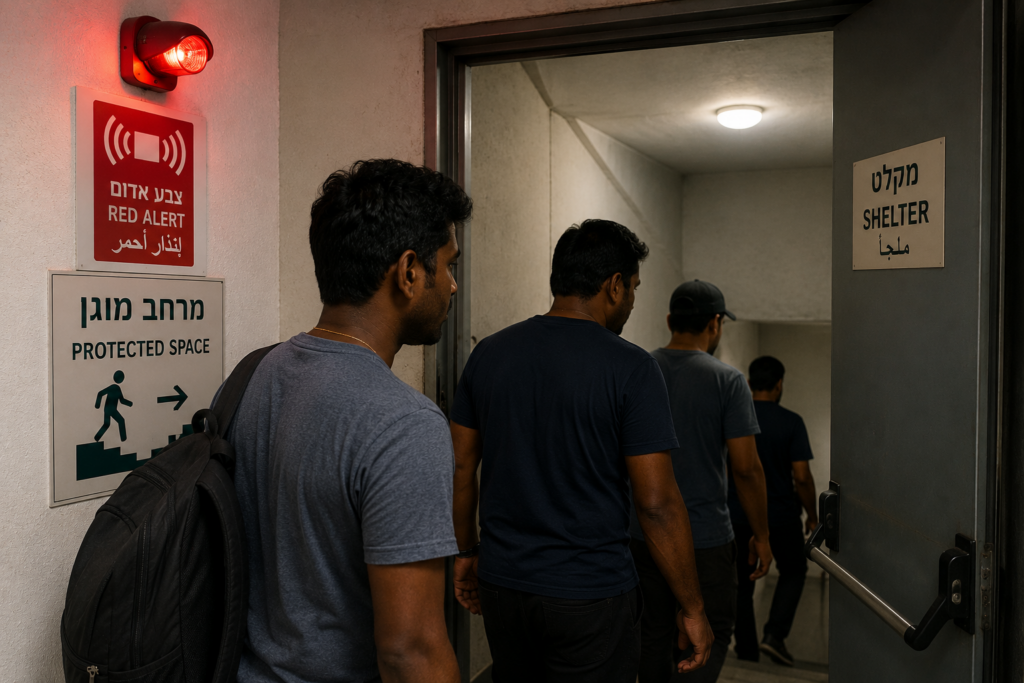
Keywords: war alert Israel, rocket siren Israel, Pikud HaOref, shelter mamad, Home Front Command, foreign workers Israel, LankaConnect guide
During a siren, there is no time to learn from zero. The people who move fastest and safest are not the bravest ones. They are the ones who already knew where to go before the sound began.
Official Home Front Command instructions change by city, building type, and security situation. Always follow the current alert rules in your area, including the time allowed to reach protected space.
Before any siren
The safest workers are the ones who already know where their protected space is. Find it before you need it. That may be a protected room (mamad), a building shelter, a public shelter, a stairwell, or another officially recommended protected area depending on your building.
Download the Pikud HaOref (Home Front Command) app and confirm your alert area. Keep shoes, keys, phone charger, medicine, and a flashlight where you can reach them quickly. If you live with elderly people, children, or someone with limited movement, plan how you will move together before an actual alert.
When the alert starts
Move. The first seconds matter more than anything else. Stop showering, cooking, or collecting belongings the moment the siren sounds. Outside, go to the nearest protected place you can reach within the available time. Driving, follow current official guidance for alerts rather than inventing your own rule in panic.
Once inside the protected space, stay there for the time required by official guidance. Leaving early because the noise seems over is one of the most common mistakes. Another is standing in a doorway or balcony to check what happened outside.
What workers often forget
Many foreign workers share crowded housing. In that situation, confusion is common: one person thinks the shelter is downstairs, another thinks it is outside, a third keeps looking for their passport. Talk about this before the next alert. Decide who helps whom and what must never delay movement.
After a siren, send one short message when safe: “I am in shelter and okay.” That message reduces panic for family abroad more than a long explanation sent late.
At your workplace
Learn your workplace shelter plan, not only your home plan. A worker who knows the route in their apartment but not in the factory, farm, kitchen, or care setting is still unprepared. Ask in advance where to go, who gives the instruction, and how to help a patient, resident, or co-worker who cannot move quickly.
Conclusion
War alerts are frightening because they demand movement before your mind fully catches up. People usually cope better when they already know the route, keep the Pikud HaOref app active, and treat every alert as real until official guidance says otherwise.