


Introduction
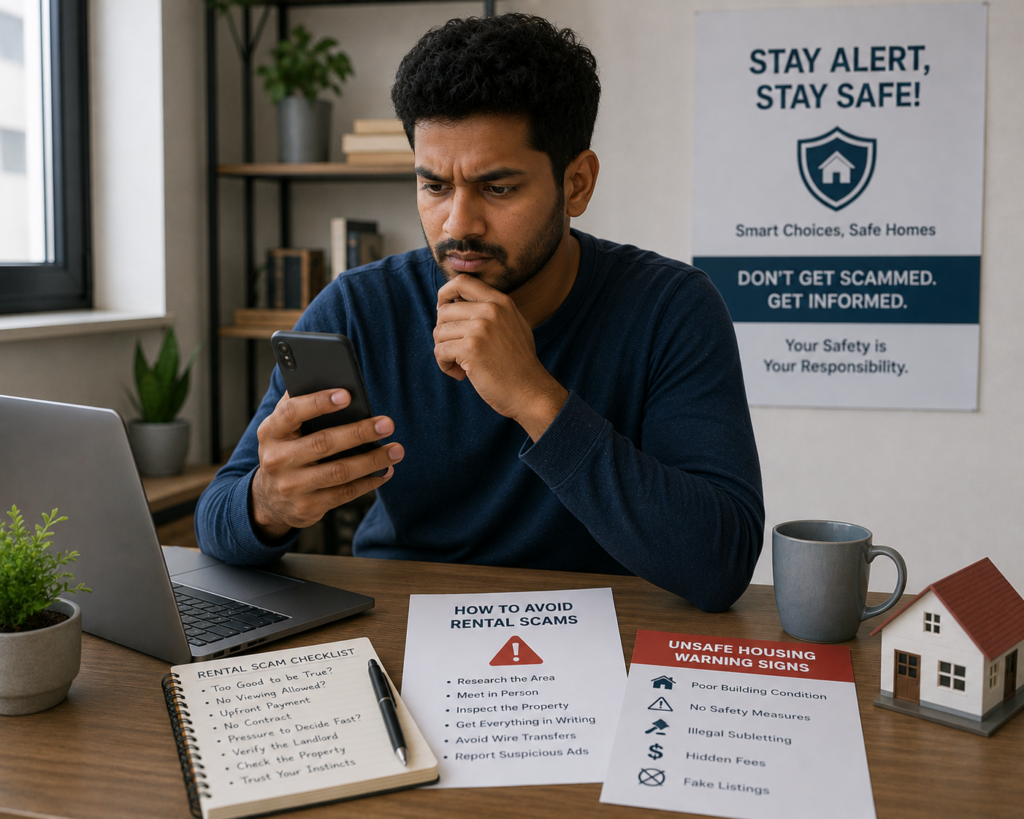
It usually starts with urgency. A room appears at a good price, but someone else is already looking at it. The message says: decide today, send the deposit now, visit later. That pressure is the mechanism of most housing scams. The room may not exist, the deal may not be what was described, or the person collecting the money may have no right to rent the place at all.
This article explains how to spot warning signs before money is lost. It is written for Sri Lankan foreign workers in Israel who need practical steps, not complicated legal language.
Final decisions should always be checked against written documents, the actual property and current official information.
Why scams work on tired workers
Housing scams succeed most often on people who are tired, new to an area, short on time or afraid that a good option will disappear. In that state, the mind focuses on the advertised price and the available date and stops asking the questions that matter.
Scammers understand this. The pressure they create is deliberate. Someone who has been looking for a room for two weeks and finally sees something affordable will naturally want to move quickly. A well-designed scam uses that moment to skip the inspection, skip the contract and collect money before anything is verified.
The safest workers are not always the most experienced. They are the ones who slow down when someone else is trying to rush them.
Warning signs that appear before payment
Extreme urgency is the most recognisable warning sign. A real landlord may want a quick decision, but requiring a money transfer within ten or twenty minutes before seeing the property or the contract is not a standard rental practice.
Refusal to show the property in person is another warning. There are legitimate reasons why a landlord may not be available on a specific day. Refusing to allow any visit, or offering only a brief photo call where the camera moves quickly past the details, is a different situation.
A price much lower than similar rooms in the same area should create questions, not comfort. A cheap room sometimes exists for good reasons. A price that makes no sense compared to everything else nearby usually means either the property is not what it appears or the deal is not what it seems.
Inconsistent stories are also a reliable warning. If the number of roommates changes, if the person collecting money differs from the name on any document, or if a previous explanation no longer matches what is being said now, treat the entire deal as uncertain.
What unsafe housing actually looks like
Unsafe housing is not only about fraud. It is also the room described as private space but actually shared by six people. It is the overloaded bathroom that makes washing before work difficult. It is the entrance that is not lit, the door that does not lock properly, the electrical wiring that does not look right.
When you visit a place, do not look only at the room offered. Look at the shared kitchen, the bathroom, the communal spaces, the entrance, the windows and the locks. Look for damp walls, strong smells, signs of overcrowding and anything that appears to have been recently covered or repainted.
If the person showing the room becomes uncomfortable when you look beyond the main room, that is information.
How to protect your payment
The safest payment is one that leaves a clear trail. A bank transfer with a written description, or a receipt that names the amount, the date, the address and the purpose of the payment, creates a record that can be used later if a dispute arises.
Cash paid in person should always be followed by a receipt. If the landlord or agent becomes irritated at a request for a receipt, that reaction itself is worth noting.
Never pay a deposit before you know the full address, the move-in date, what the payment covers and what conditions would allow a refund. If any of these four pieces of information is missing, the payment is premature.
Keep screenshots of the original advertisement, every version of the conversation, any payment requests and the name of every person involved. Scams often depend on disappearing messages and explanations that change over time.
The day the story changes
One of the clearest signs that a deal is not honest is when the explanation changes. The property was available, then someone else made an offer. The landlord was out of town, then she is back but has a different address to show. The deposit was a standard amount, then it becomes a non-refundable reservation fee.
Every change in the story deserves a direct question: why is this different from what you said before? A legitimate landlord who simply miscommunicated will explain calmly. A person running a scam will create more pressure or become evasive.
The right response to a story that keeps changing is not to ask more questions hoping for a straight answer. The right response is to stop the process until the original facts can be verified.
Conclusion
Most rental scams are easier to stop before payment than after it. The mechanism is always the same: urgency, vague documents, inconsistent information and a request for money before anything is verified.
A safe housing deal has:
- A real address you can visit
- A clear agreement you can read before signing
- A payment method that leaves proof
- A story that stays consistent from beginning to end
If any of those four things is missing, the deal is not ready.