


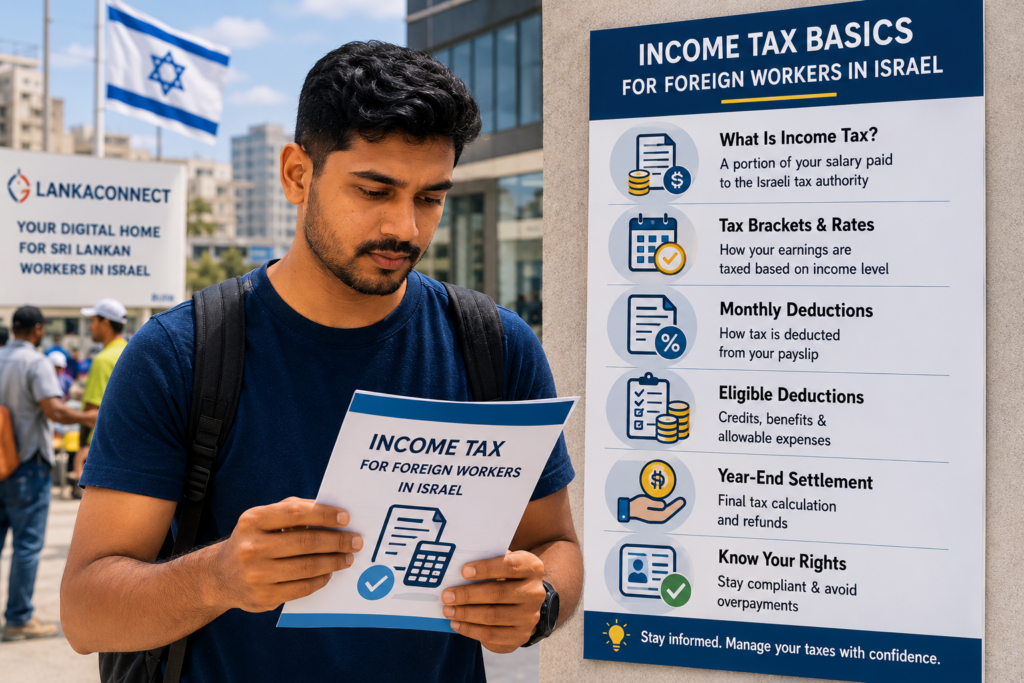
Income tax is one of the biggest sources of confusion on an Israeli payslip. Many workers know that tax exists, but they do not know how it is calculated, why it changes from one month to another, or what they can do if too much tax was taken.
For foreign workers, the confusion is often greater. The worker may be new to Israel, may not read Hebrew, and may receive explanations through friends or social media instead of official payroll language. In many cases, the worker sees only one line on the payslip and assumes it is either fully correct or impossible to challenge.
That is not the right approach. A worker does not need to master the whole Israeli tax system, but every worker should understand the basics: what income tax is, how it differs from National Insurance, why the amount can change, which forms matter, and when it may be worth checking for a correction or refund.
What income tax is
Income tax is a tax taken from earnings according to legal rules. In employment, the employer usually withholds tax from salary and transfers it to the tax authorities. That means many workers pay tax during the year automatically through payroll.
Income tax is different from National Insurance and different from private medical insurance. National Insurance relates to separate social-insurance branches. Private medical insurance relates to health coverage. Income tax is simply tax on income. These lines may all appear near each other on a payslip, but they serve different purposes.
This distinction matters because workers often use the wrong word when asking questions. If the problem is tax, ask about tax. If the problem is National Insurance, ask about National Insurance. Clear language usually gets clearer answers.
Why the tax amount can change
Workers sometimes panic when they see a different tax amount from one month to the next. A change does not always mean there is a mistake. Tax can change because gross salary changed, overtime increased, unpaid leave reduced the salary pattern, a bonus was paid, a second job existed, or the employer corrected earlier payroll data.
Tax may also change because an employee form was missing, not updated, or completed incorrectly. In Israel, Form 101 is the basic employee card used for tax withholding purposes. Employers use employee information from this process when calculating salary tax. If a worker starts a job and the employer does not have the proper information, tax withholding can become less accurate.
This is one reason why workers should complete onboarding documents carefully and keep copies whenever possible. A small form problem can create a bigger tax problem later.
What foreign workers should review on the payslip
A good tax review starts with the gross salary, not the net salary. First, check how many workdays or hours were recorded. Second, check the gross pay. Third, look at the tax line. Fourth, compare the result with previous months. If the tax amount changed sharply, ask why.
Do not ask only, “Why is my net salary lower?” That question is too broad. A stronger question is: “My gross salary and hours look similar to last month, but the income tax line is much higher. Please explain the reason.” This makes payroll review easier.
Workers should also save year-end salary summaries when they receive them. These summaries are important if a later correction, tax coordination, or refund review becomes necessary.
The difference between legal tax and over-withholding
It is important to understand that a tax deduction can be legal in form but still too high in practice if the payroll information used for withholding was incomplete or inaccurate. For example, if an employer assumes the highest withholding approach because documents were missing, the tax line may be higher than it should be.
This does not automatically mean the employer acted maliciously. Sometimes it means the payroll process was cautious, incomplete, or not updated. The solution is not panic. The solution is document review.
In other words, workers should separate three questions: Was tax supposed to be taken at all? Was the amount reasonable based on the available data? If the amount was too high, can it be corrected during the year or later through a refund process?
Key documents that matter
The most useful tax documents for an employee are usually the monthly payslip, Form 101 or equivalent employee information paperwork, identity and visa documents, and the year-end salary summary. If the worker had two jobs, then records from both employers matter. If the worker changed jobs during the year, records from each period matter.
Without documents, tax conversations become emotional and confused. With documents, they become technical and easier to solve.
When a foreign worker may need extra attention
Foreign workers should pay extra attention when they start a new job, return after a break, hold two jobs, receive a one-time bonus, work unusual overtime patterns, or see a sudden tax jump that payroll cannot explain clearly.
They should also pay attention if they worked only part of the year. In some cases, workers who did not work a full year may later discover that too much tax was withheld during the months they did work. That does not guarantee a refund, but it is one reason year-end review matters.
Practical example 1: tax changed after overtime
A worker normally earns a regular monthly salary. In one month, she works much more overtime and her gross salary rises. At the end of the month, she sees more income tax than usual. This may be normal because the higher monthly earnings affected withholding. The right first step is not accusation. The right first step is to compare gross salary, overtime, and tax side by side.
Practical example 2: started a new job and tax is unexpectedly high
A worker begins a new job and forgets to finish all employee paperwork on time. The first payslip shows a surprisingly high tax deduction. Later, after the form is completed properly, the payroll may be corrected or future withholding may change. This example shows why onboarding documents matter.
Practical example 3: worked only part of the year
A worker arrived in Israel mid-year, worked for several months, and had tax withheld each month. After the year ends, the worker hears that a review may be useful because the annual picture was different from a full-year worker. This does not mean an automatic refund, but it is a valid reason to gather documents and check.
Form 101 and why it matters
The Israel Tax Authority explains that Form 101 is the employee card used by employers for tax benefits and withholding purposes. Even workers who do not like paperwork should take this form seriously. A wrong detail, missing declaration, or unreported change can affect withholding.
Workers do not need to guess the legal meaning of every line on the form, but they should make sure the basic information is accurate and should keep a copy when possible. If a worker cannot read the form language comfortably, translation help is worth using before signing.
What to do if the tax line looks wrong
Start with comparison, not conflict. Compare this month’s payslip with the previous one. Check gross salary, workdays, overtime, bonus lines, and the tax line. If the change still looks strange, send a short written question to payroll or the employer.
A useful message is: “Hello, I reviewed my payslip and I need help understanding the income tax line for this month. My gross salary looks similar to last month, but the tax deduction is different. Please explain the reason.”
If the answer is vague, ask for the basis of the calculation or ask whether any employee information was missing. Keep every reply.
Tax refunds and year-end review
The online tax coordination service of the Israel Tax Authority notes that if, at the end of the year, the tax actually paid was higher than required, a person may apply for a tax refund for up to six years back from the end of the relevant tax year. This is important because many employees wrongly believe that a payroll mistake can never be corrected later.
A refund is not automatic and not every worker will qualify. But the possibility exists, and it is a strong reason to keep documents carefully. Workers who had changing jobs, multiple jobs, or part-year employment should be especially careful with year-end files.
Common mistakes to avoid
Do not focus only on net salary. Always review gross salary and the tax line separately.
Do not assume a high tax line means fraud. Sometimes it means missing information or a payroll method that needs correction.
Do not sign forms you do not understand without asking for help.
Do not throw away year-end salary summaries.
Do not wait many months before asking why the tax line changed.
Simple worker checklist
Keep every payslip in one folder.
Save your first-job documents and any Form 101 copy you receive.
Compare months where tax changed sharply.
Keep records from every employer if you changed jobs.
Review the year-end summary before deleting or losing old files.
Ask written questions early and politely.
Conclusion
Income tax does not have to remain a mystery. For most foreign workers, the right approach is simple: understand the difference between tax and other deductions, keep the main documents, compare payslips month to month, and ask clear questions when the numbers change.
Workers do not need expert-level tax knowledge to protect themselves. They need order, patience, and records. A good payslip habit can prevent confusion, reduce over-withholding risk, and make it easier to check for corrections or refunds later.
For website publication, this topic should be presented in practical language, because workers benefit most from examples, comparisons, and step-by-step review—not from heavy legal wording.