


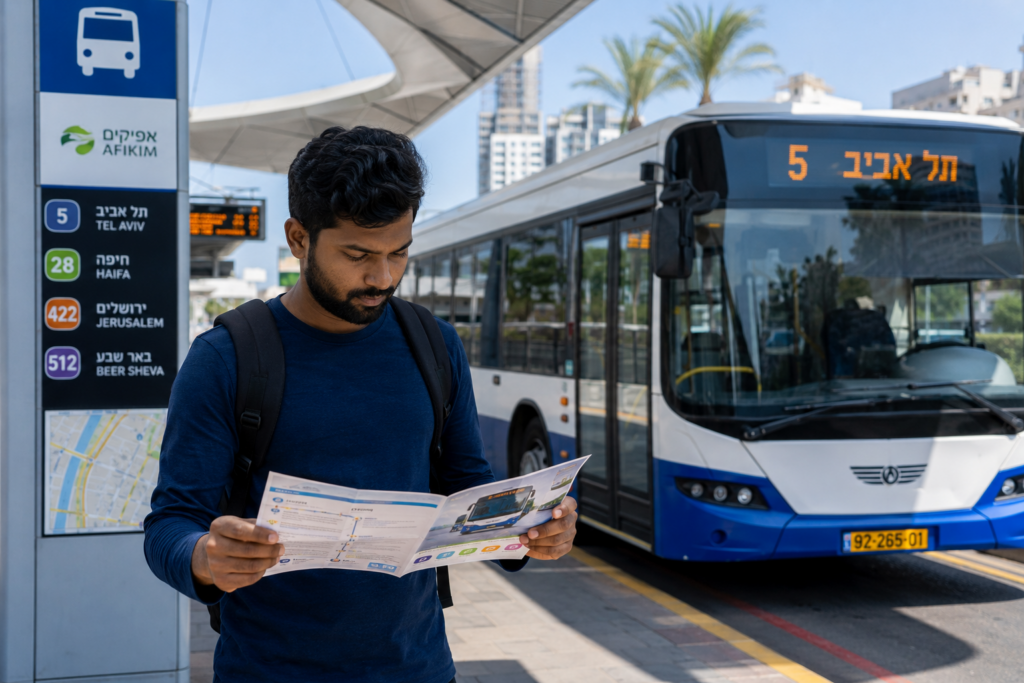
Introduction
For many workers, transport shapes the whole week. It affects when you leave the house, whether you reach work calmly, how much you spend on taxis, and whether a free day feels simple or exhausting.
Israel has a large transport network, but it is not always intuitive at first. Operators differ by city, trains have their own timing, and Friday nights, Saturdays, holidays, and security events can change service in ways that surprise new arrivals.
You do not need to master the whole system at once. A few reliable habits will handle most situations: how you pay, where you check live updates, and how to plan the full journey from door to door.
What the system looks like in real life
Most workers use a mix of city buses, intercity buses, trains, and in some areas light rail. One trip may involve all of them: a short bus from home, a train between cities, and another bus or walk at the destination.
The weak point is often the transfer or the final walk, not the main ride. People who plan only the long middle section often end up paying for a taxi at the last mile.
Shabbat: the biggest schedule change of the week
Every week, public transport shuts down almost completely for Shabbat. This begins on Friday at sunset — somewhere between 4 PM and 6 PM depending on the season — and full service does not return until Saturday night, roughly an hour after dark.
Workers who need to travel on Friday evenings or Saturdays should plan around this. Missing the last pre-Shabbat bus means a taxi, and that cost can be significant. Check the last departure time before every Friday trip, alongside the arrival time.
Shabbat transport warning
Last buses before Shabbat run 30–60 minutes earlier than usual — not at the regular final time.
The cutoff changes each week as daylight shifts with the season. Verify each Friday.
Some routes stop earlier than others. Check each route individually, not just the city schedule.
Payment and route checking
Public transport payment across most of Israel uses a Rav-Kav travel card or an approved app. Cash is not always accepted when boarding, so do not assume it will work. Carry a funded card or a charged phone.
Keep one main payment method funded before it runs low. A backup option for important days removes most payment emergencies before they happen.
For live route information, the app most people in Israel use is Moovit. Download it and practice on a low-pressure day. A screenshot from a friend taken last month is never enough for an important trip.
How to plan better
Good planning covers the full journey: the walk to the stop, the transfer time, and what happens if the first vehicle is late.
For a hospital visit, airport trip, government appointment, or first day at work, build extra time into the journey. Transport is cheap, but a missed appointment costs far more than one early bus.
Habits that save money and stress
- Reload the card or app before the balance runs empty
- Check the route again on the day if the trip is important
- Save your nearest station names in English and Hebrew
- On Fridays, check the last pre-Shabbat departure — not only the outgoing trip
- Before a long day out, check the last useful connection home
- Keep one backup route for work and one backup payment method for serious trips
Conclusion
Learning the transport system does not need to happen all at once. Focus on a reliable payment method, a way to check live service with Moovit, and a plan that covers the whole journey — not just the main ride.
Those three habits will prevent most transport problems before they start.
Ask the Expert
“I live far from a train station and buses in my area run less often on Fridays. How do I find the safest return option for late Friday evenings?”
Submit your question: LankaConnect.com/ask-the-expert