


Introduction
Life in Israel usually becomes stable in small, ordinary ways long before it feels stable emotionally. A worker may still miss home or feel pressure, yet become far safer and stronger simply by building repeatable routines, choosing trustworthy people, and keeping daily life less chaotic.
This guide is not about becoming perfect. It is about becoming steady. A worker who sleeps better, keeps order in money and paperwork, chooses community carefully, and plans week by week is usually stronger than a worker who tries to solve everything in one emotional push.
What stability really means
Stability is not only about salary. It usually has six parts working together: legal order, housing order, money order, physical health, emotional balance, and social boundaries.
A worker can earn money and still feel unstable if sleep is poor, family demands are constant, or every small problem turns into panic. In the same way, a worker can face hard weeks and still remain stable because the basic structure of life is strong.
Start with a weekly structure
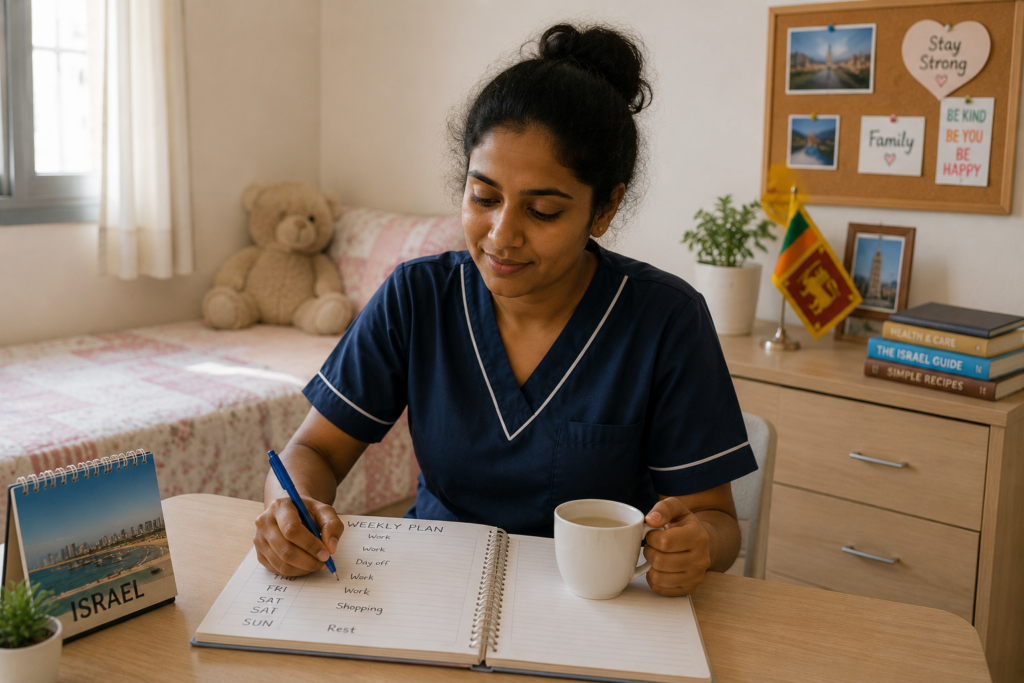
One of the biggest differences between surviving and stabilizing is routine. A weekly structure reduces mental noise. It helps a tired worker make fewer rushed decisions.
- Choose one fixed time each week to review money, messages, work schedule and key documents.
- Keep one place for passport copy, visa copy, employer details, health insurance details and emergency numbers.
- Decide in advance when to rest, when to call home and when not to answer non-urgent messages.
- Build simple habits you can keep even during stressful weeks.
Build a life around trusted circles, not around noise
Workers far from home are often surrounded by many voices: roommates, agents, community admins, relatives, friends, social media and rumors. Stability grows when you reduce the number of voices that influence your decisions.
Try to separate people into circles. The first circle is people you truly trust. The second circle is people who may help with information but should not control your choices. The third circle is noise: dramatic opinions, gossip, pressure and people who appear only when they want something from you.
Protect your emotional energy
Workers often think emotional strength means accepting every burden quietly. In real life, emotional strength usually means knowing where your energy goes.
If every day includes pressure from work, from home and from your phone, you will eventually make weaker decisions. Protecting energy may mean limiting calls late at night, leaving unhealthy groups, spending one free hour alone, or refusing to explain the same personal decision ten times.
Money systems create emotional stability
Even though this category is not about loans or debt, money order still matters. Many emotional crises are really problems of confusion: not knowing what you can send home, what you must keep, what dates matter and what amount is actually safe.
Workers who feel stable usually know three numbers: what comes in, what must stay in Israel, and what can safely be sent or saved. Without these three numbers, every family request feels like an emergency.
Keep your identity while adapting
Living in another country always changes a person. The goal is not to copy everyone around you, and it is not to reject everything around you either. Healthy adaptation means learning how to function well in Israel without losing your values, faith, language and self-respect.
Small acts matter: speaking Sinhala with family, observing your religious practices when possible, celebrating meaningful days, cooking familiar food, or keeping one personal ritual that makes you feel like yourself.
Signs that your life needs a reset
Watch for patterns, not only dramatic events. You may need a reset if you are always exhausted, always sending money without a plan, hiding problems from everyone, losing documents, fighting often, skipping rest, or feeling that every message from home creates fear.
A reset does not mean your life is failing. It means your system needs rebalancing before a bigger problem appears.
A practical 30-day reset plan
- Week 1: clean your phone, save key numbers, organize documents and write down fixed costs.
- Week 2: reduce noisy chats, clarify one family expectation, and set one personal sleep or rest habit.
- Week 3: review your support circle, identify one trusted person, and cut one unhealthy pattern.
- Week 4: set a goal for the next three months that is bigger than just getting through the week.
Conclusion
A stable life in Israel is not built through one lucky month. It is built through repeatable habits, calmer decisions and stronger boundaries. The worker who becomes steady is usually the worker who learns to protect both money and peace of mind.
If your life currently feels scattered, start with the smallest stable step: one folder, one schedule, one boundary, one budget, one healthier routine. Stability grows from there.