


Introduction
Sending money home is often an act of care, pressure, and routine all at once. Many workers send money while tired, busy, or emotionally stressed because family needs are urgent. That is exactly why safe habits matter.
This guide is not only about avoiding fraud. It is also about avoiding ordinary mistakes: wrong account numbers, rushing during bad exchange rates, weak proof of payment, or sending through people who cannot solve a problem later.
Build one clean sending routine
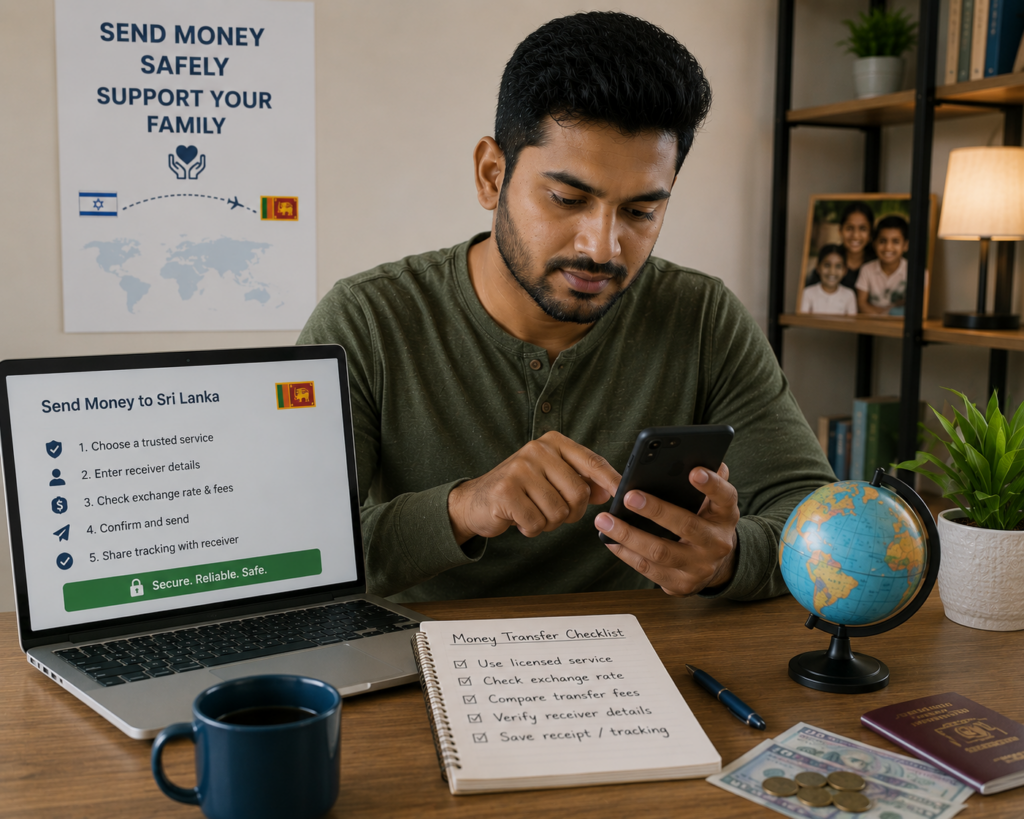
Use the same calm steps every time. Check the recipient details, compare the final receive amount, make the payment, save the confirmation, and send your family only the information they actually need.
Routine reduces mistakes. It also helps you spot when something looks different from normal.
Protect family information
Do not share full personal details in open group chats. A screenshot with full name, account number, national ID, and transfer code may be convenient in the moment, but it can also circulate much further than you expect.
Send sensitive information only through a direct private channel and only when needed. If cash pickup is involved, be careful about who sees reference numbers and instructions.
Choose licensed and traceable channels
Use banks or licensed transfer services that give you a real confirmation, a transaction number, and a support path if the money is delayed. In Israel, licensed payment service providers are regulated by the Bank of Israel. If you are unsure whether a transfer service is licensed, the Bank of Israel website publishes a list of approved payment service providers that you can check.
If the only proof is a chat message from a person acting as a middleman, the risk is too high. Safety in remittances is strongly linked to traceability.
Check the receive side, not only the send side
Many senders feel finished the moment the payment leaves Israel. Safe sending continues until the family confirms the money arrived in the right place, in the right amount, and without unexpected deductions.
If the transfer is for a specific purpose, such as tuition or a hospital payment, check that the purpose was actually completed.
When to slow down
Slow down when the amount is unusually large, when you are using a new provider, when the family suddenly asks for a different recipient, or when somebody pushes you to send immediately with little explanation. Urgency is the condition under which most transfer mistakes happen.
The mistakes that create the most problems
Two mistakes cause most transfer failures.
The first is skipping verification: assuming last month’s recipient details are still correct, or relying on memory rather than checking the name and account number in writing before sending.
The second set of mistakes happens around proof and timing: sending a large urgent amount through a new route without understanding its support process, deleting the transfer confirmation before the family confirms receipt, and misreading delays.
Most transfer delays are technical and resolve without action. An unexplained delay on a traceable transfer, however, deserves a direct message to the provider rather than waiting and hoping.
Real-life examples
A worker sent money to a relative’s new account after receiving the details in a hurried voice note. One digit was wrong, and the correction process took much longer than sending would have taken if he had paused to confirm in writing.
Another worker sent cash pickup details in a group chat because it was faster. Later, the family worried that too many people had seen the code. Nothing happened, but it was an avoidable risk.
A more careful worker kept one notebook page for regular family transfers: recipient details, preferred service, normal send day, and average receive time. That small system reduced confusion every month.
Conclusion
The safest way to send money to Sri Lanka is usually not the most dramatic or fastest-looking option. It is the option that combines clear records, correct details, transparent cost, and support when things go wrong.
When money supports people you care about, safety is part of the transfer itself. A few extra minutes of checking can protect both your work in Israel and your family’s stability at home.