


Introduction
Many workers underestimate the value of what they already know. Years of reliable work build more than income. They build experience in responsibility, timing, care, communication, problem solving, and trust.
The problem is that useful experience often remains invisible unless the worker learns how to describe it, save proof of it, and connect it to future opportunities.
How to make experience visible
Instead of thinking only in job titles, think in skills and situations. Did you manage schedules? Communicate with families? Use digital tools? Handle records? Work under pressure? Solve problems alone? These details matter.
The worker who can describe their experience clearly and back it up with something written is in a far stronger position than the worker who says only “I worked there for three years.” Proof does not need to be formal. A screenshot of positive feedback, a message from an employer, or a note confirming a responsibility all count.
How to describe what you did
Most workers describe their experience in job titles: “I worked as a caregiver” or “I worked in cleaning.” These titles are true but they are also thin. A more useful description talks about what you actually managed: “I was responsible for the daily schedule of an elderly person with mobility difficulties,” or “I managed a household including shopping, cooking, and medical appointments.” These descriptions carry weight.
The question to practice is: what would a future employer or business partner need to know about what I did to trust me with something similar? Once you can answer that clearly, you have the beginning of a strong professional story.
Proof that travels with you
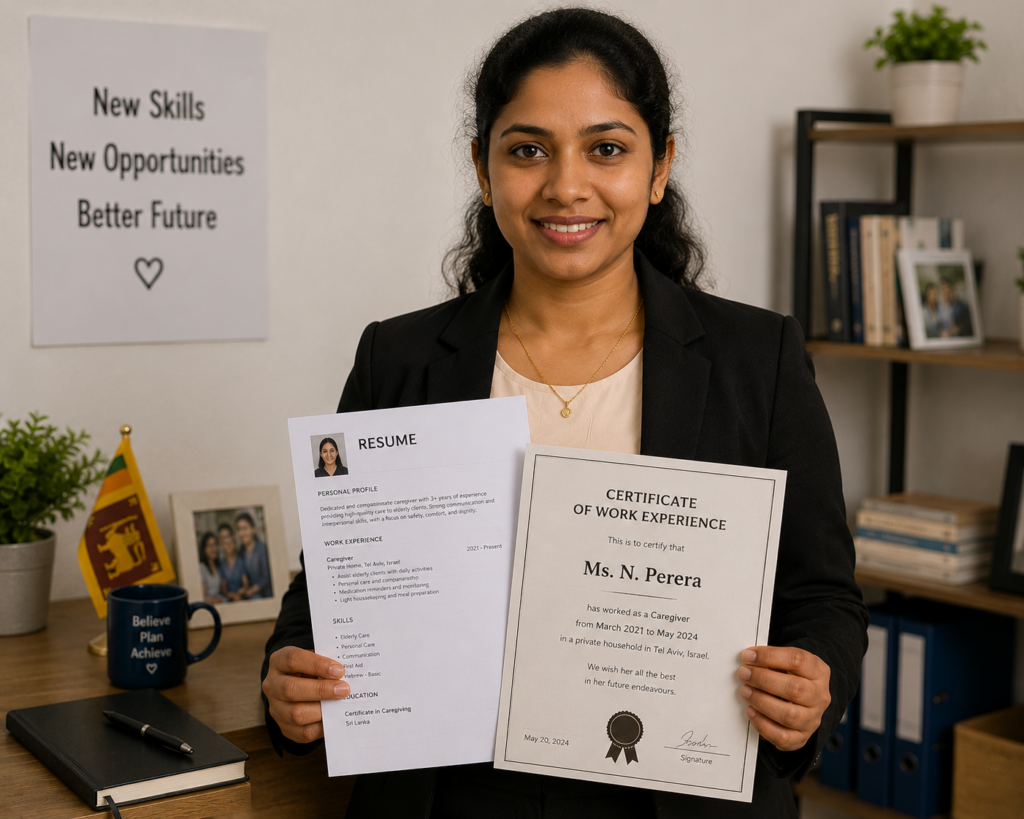
Written proof is more valuable than memory. A recommendation letter, a training certificate, a screenshot of an employer message expressing satisfaction, or a document showing you handled financial responsibilities all carry weight that verbal descriptions do not. Save these while they are still available. After leaving Israel, asking for proof from a former employer becomes difficult.
Keep digital copies in a folder you can access from Sri Lanka. Print a copy of the most important ones and keep them with your other documents. The worker who returns home with organized proof of their Israeli work experience is in a noticeably stronger position than the worker who returns with only memories and a number of years.
Connecting experience to what comes next
The bridge between past experience and future opportunity is usually built by naming what you can do clearly and connecting it to what someone else needs. If you want to work again as a caregiver, your Israeli experience is directly relevant. If you want to open a small business, your experience managing schedules, handling money, communicating across language barriers, and solving problems alone are all real assets. If you want to work in another country, documented references from Israel carry real credibility.
None of this happens automatically. It requires the worker to see the value first, name it clearly, and then make it visible to others.
Conclusion
Work experience in Israel becomes a future opportunity only when it is noticed, named, and organized. What feels ordinary today may become the strongest part of a CV, interview, or business idea tomorrow.
The best time to start building that bridge is before the current chapter ends.